I have had Tinnitus since I was 15. Its really very annoying and of course very easy for me to judge subjectively as I can hear it. I will know unequivocally if TDCs has worked or not in this case.
Unfortunately TDCs does not offer a 100% cure for tinnitus.
I need to spend 2-3 days studying the research papers before I decide upon the electrode placements.
Also thanks to http://www.diytdcs.com for linking to this blog. They have quite a good blog with general information on TDCs. You also will come across www.mindalive.com who sell light and sound devices and have many links to research on TDCs.
You may also come across the goflow device - seriously do you need to shell out $100 when a TDCs device has two resistors and a regulator ?
If you really must buy a device you may as well go the whole hog and get a medical device.
Monday, 23 July 2012

Sunday, 22 July 2012
Fourth Session Complete
Did the fourth session & second math session this evening. Nothing to report subjectively. Right electrode site stung a little after fresh scalp shave.
Friday, 20 July 2012
Subjective Observations After Three Sessions
I will need to do 10 - 20 different protocols over an extended period of time - maybe 4x each or more. I am using the curve of forgetting so I do 2 consecutive days then 7 days and a month later per protocol.
I would expect this to give a noticeable result. Doing a couple of protocols once or twice wont achieve much.
So far I have done 2 working memory sessions and a maths session.
Today I feel that something has perhaps changed. An event happened that would normally make me very stressed & angry. But it didn't. I remained calm and thoughtful. Rather than worrying I calmly considered my options without negative emotion.
Was this linked to the TDCs ? I don't know but it was not how I would normally respond to the event.


My First TDCs Math Session
I used the online vedic maths software. Prior to the session I shaved my head & fresh disposable ECG electrodes were used on P3 & P4


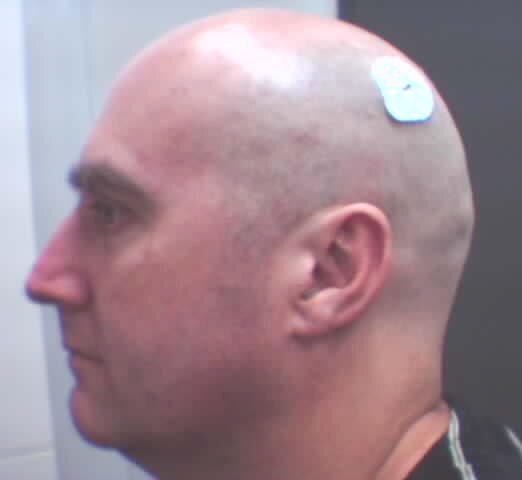

I did the session for 20 minutes and will repeat tomorrow. There was a mild tingling at the begining. I have not done extensive training with the Vedic Maths software yet so I have no subjective opinion on the experience.
My electrode placements were approximated from illustrations.
Wednesday, 18 July 2012
The TDCs Math Protocol
The electrode placements for the math protocol are illustrated in a previous post. For this protocol I will be using Vedic Math software.
Vedic Math is a very detailed Indian system of mental calculation. A wonderful skill if you are interested in mathematics. I will be doing basic arithmetic problems initially but with vedic math that means adding very substantial figures rapidly in ones mind.
I will brush up on my technique first then perform the TDCs protocol for 20 minutes.
For this session I will shave my head - which is largely bald anyway.
There are many sources for Vedic Math software and I did an extensive search some time ago.
A Mental Math trainer you can download is available here http://www.jimmyr.com/blog/Speed_Math_Trainer_Program_126_2006.php
There are other superior applications also but the above will suffice for most people initially.
I dont recommend you do this using normal math techniques - its a waste of time. Best to take advantage of the TDCs to learn advanced mental arithmetic methods.
A better online trainer that is specifically for Vedic Techniques:
http://mastermindvedicmaths.com/vedic.php?pro=2
Once you get a taste for mental calculation it becomes very rewarding.
Vedic Math is a very detailed Indian system of mental calculation. A wonderful skill if you are interested in mathematics. I will be doing basic arithmetic problems initially but with vedic math that means adding very substantial figures rapidly in ones mind.
I will brush up on my technique first then perform the TDCs protocol for 20 minutes.
For this session I will shave my head - which is largely bald anyway.
There are many sources for Vedic Math software and I did an extensive search some time ago.
A Mental Math trainer you can download is available here http://www.jimmyr.com/blog/Speed_Math_Trainer_Program_126_2006.php
There are other superior applications also but the above will suffice for most people initially.
I dont recommend you do this using normal math techniques - its a waste of time. Best to take advantage of the TDCs to learn advanced mental arithmetic methods.
A better online trainer that is specifically for Vedic Techniques:
http://mastermindvedicmaths.com/vedic.php?pro=2
Once you get a taste for mental calculation it becomes very rewarding.
Electrode effects on second session
An interesting session tonight - first up it seems to work. My N-Back score while not out of the ball park is much easier and faster to progress. There is no doubt of that. I don't know if its placebo. Plenty of other people have done studies that prove it is not.
What was interesting tonight is the electrodes. I am bald on the front and have very short hair so I wont need foam electrodes - I am using disposable ECG electrodes.
Tonight I shaved the fine hair from the left hemisphere electrode position. As soon as I switched the device on there was a mild tingly sting at the electrode site.
I was stingy and used one of yesterdays electrodes for the position above my right eye. It had a tiny tear and part way through the session I felt my nerve above my eye in the forehead. At the same time there was a white flash in my right eye. This happened several times and I removed the old electrode and replaced it with a new one.
No harm done but very interesting. I will use fresh electrodes and shave the sites for every session now.
What was interesting tonight is the electrodes. I am bald on the front and have very short hair so I wont need foam electrodes - I am using disposable ECG electrodes.
Tonight I shaved the fine hair from the left hemisphere electrode position. As soon as I switched the device on there was a mild tingly sting at the electrode site.
I was stingy and used one of yesterdays electrodes for the position above my right eye. It had a tiny tear and part way through the session I felt my nerve above my eye in the forehead. At the same time there was a white flash in my right eye. This happened several times and I removed the old electrode and replaced it with a new one.
No harm done but very interesting. I will use fresh electrodes and shave the sites for every session now.
Tuesday, 17 July 2012
My first TDCs session went fine
My first session went fine - I did the working memory protocol
Subjectively it worked initially very well but them my WM session went to custard
I used the N-Back software off sourceforge Brain Workshop
Really the second half went like a normal session - at first I stomped through 4 levels though - easier than normal.
What was different and important ...
I am an artist and can have a very lucid imagination - well all night I could not sleep - I had 3D images flashing through my mind all night - It actually becomes a pain in the ass if they are not of stuff you want to see but its always a buzz to have vivid visualizations.
So I will do the Working memory session again tonight - tomorrow I will do maths.
I am using the curve of forgetting to determine reinforcement dates.
After that I will try visual stimulation & tinnitus protocols


Monday, 16 July 2012
Curve of Forgetting to Reinforce Conditioning


On day one, at the beginning of the lecture, you go in knowing nothing, or 0%, (where the curve starts at the baseline). At the end of the lecture you know 100% of what you know, however well you know it (where the curve rises to its highest point).
By Day 2, if you have done nothing with the information you learned in that lecture, didn't think about it again, read it again, etc. you will have lost 50%-80% of what you learned. Our brains are constantly recording information on a temporary basis: scraps of conversation heard on the sidewalk, what the person in front of you is wearing. Because the information isn't necessary, and it doesn't come up again, our brains dump it all off, along with what was learned in the lecture that you actually do want to hold on to!
By Day 7, we remember even less, and by Day 30, we retain about 2%-3% of the original hour! This nicely coincides with midterm exams, and may account for feeling as if you've never seen this before in your life when you're studying for exams - you may need to actually re-learn it from scratch.
You can change the shape of the curve! A big signal to your brain to hold onto a specific chunk of information is if that information comes up again. When the same thing is repeated, your brain says, "Oh-there it is again, I better keep that." When you are exposed to the same information repeatedly, it takes less and less time to "activate" the information in your long term memory and it becomes easier for you to retrieve the information when you need it.
Here's the formula, and the case for making time to review material: Within 24 hours of getting the information - spend 10 minutes reviewing and you will raise the curve almost to 100% again. A week later (Day 7), it only takes 5 minutes to "reactivate" the same material, and again raise the curve. By Day 30, your brain will only need 2-4 minutes to give you the feedback, "Yup, I know that. Got it."
Often students feel they can't possibly make time for a review session every day in their schedules - they have trouble keeping up as it is. However, this review is an excellent investment of time. If you don't review, you will need to spend 40-50 minutes re-learning each hour of material later - do you have that kind of time? Cramming rarely plants the information in your long term memory where you want it and can access it to do assignments during the term as well as be ready for exams.
Depending on the course load, the general recommendation is to spend half an hour or so every weekday, and 1½ to 2 hours every weekend in review activity. Perhaps you only have time to review 4 or 5 days of the week, and the curve stays at about the mid range. That's OK, it's a lot better than the 2%-3% you would have retained if you hadn't reviewed at all.
Many students are amazed at the difference reviewing regularly makes in how much they understand and how well they understand and retain material. It's worth experimenting for a couple weeks, just to see what difference it makes to you!
TDCs electrode positioning
| Anode Electrode Positioning | Cathode Electrode Positioning | Observations | Caveats |
| Primary Motor cortex (M1) | Supra-Orbital | This is the most used montage. It has been proven that the cortical excitability can be changed up to 40%6 (Figure 6). Anodal stimulation results in neuronal depolarisation and increasing neuronal excitability while cathodal stimulation has opposite results6. | Only one motor cortex is stimulated – might be a problem for bilateral pain syndromes. Also the confounding effect of the supra-orbital electrode needs to be considered. |
| Primary Motor cortex (M1) | Primary Motor cortex | - Interesting approach when there is a bi-hemispheric imbalance between motor cortices (such as in stroke) - Can be used with two anodal stimulation electrodes (see sixth row), where cathodal electrode is placed in the supraorbital area for instance. | Electrodes might be too close to each other- issue of shunting. A decrease of the area of the electrodes will increase the degree of shunting along the skin 19 Therefore shunting might be related not only to electrode positioning but also to electrode size. The relative resistance of the tissues is dependent upon the electrode position and size- the overall resistance on which the current flows is dependent upon the electrode properties19. |
| Dorsolateral Prefrontal Cortex (DLPFC) | Supra-Orbital | Most used for DLPFC stimulation – positive results for treatment of depression20 and also chronic pain3. | Only unilateral DLPFC stimulation situation is possible with this montage. |
| Dorsolateral Prefrontal Cortex | Dorsolateral Prefrontal Cortex | - Interesting approach when there is a bi-hemispheric imbalance. - Can be used for a two anodal stimulation situation (see sixth row), where cathodal electrode is placed in the supraorbital area for instance. | Electrodes might be too close to each other- issue of shunting 19. (Please see second row, fourth column). |
| Occipital | Vertex | Interesting active control for chronic pain trials or for modulation of visual cortex. | When used as active control, reference electrodes are placed in different locations- problem of comparability between intra- and inter- experimental approaches. |
| Two anodal electrodes, e.g. both Motor cortices | Supra-Orbital | Simultaneous change in cortical excitability | Transcallosal inhibition might add a confounding factor21 |
| One electrode over a cortical target, e.g. Primary Motor cortex (M1) | Extra-Cranial | Avoid the confounding effect of two electrodes with opposite polarities in the brain7. | Depending on intended target, current distribution might not be optimal and therefore induce ineffective stimulation22 |
Table 2. Electrode Positioning
Images Of Several Protocol Placements:


Figure d is that used for "Working Memory" enhancement. The Anode is placed on the Dorsolateral prefrontal cortex of the left hisphere, the cathode on the supra orbital above the right eye.
Saturday, 14 July 2012
Software for TDCs training
There is a great N-Back program on source forge for working memory training called Brain Workshop
I will use that for the working memory protocol & have been using it anyway
I also will be training with Vedic Math software for mental calculation - this also utilizes working memory but I will use the Math protocols with this software.
As for the protocols them selves there is a great deal of scattered information.
This PDF lists several relevant electrode sites
http://www.mindalive.com/1_0/article%2011.pdf
Great care must be taken in selecting the placement areas and the polarity of the electrodes.
I will use that for the working memory protocol & have been using it anyway
I also will be training with Vedic Math software for mental calculation - this also utilizes working memory but I will use the Math protocols with this software.
As for the protocols them selves there is a great deal of scattered information.
This PDF lists several relevant electrode sites
http://www.mindalive.com/1_0/article%2011.pdf
Great care must be taken in selecting the placement areas and the polarity of the electrodes.
My Transcranial Direct Current Device

This is the circuit I eventually chose to build my device. It cost very little to make.
I tested it on a breadboard first. I would consider this to be a bare minimum circuit.
I stuck it into an old TENS machine case.
My TDCs Experiment
My name is Gareth Morgan Thomas. I am an electronics engineer amongst many things and am interested in cognitive enhancement.
To this end I have built a TDCs device and am awaiting my disposable electrodes which I will have in 2 days.
I will initially use the protocols for math improvement and working memory.
I also want to use drawing and art to improve my visual memory and imagination so I will use TDCs to this end also.
My objective is general intelligence enhancement.
At some point I will test my IQ and then again after various protocols.
I will utilize the curve of forgetting to reinforce the TDCs rather than just using a protocol once.
This blog is to be the journal of my experimentation.
To this end I have built a TDCs device and am awaiting my disposable electrodes which I will have in 2 days.
I will initially use the protocols for math improvement and working memory.
I also want to use drawing and art to improve my visual memory and imagination so I will use TDCs to this end also.
My objective is general intelligence enhancement.
At some point I will test my IQ and then again after various protocols.
I will utilize the curve of forgetting to reinforce the TDCs rather than just using a protocol once.
This blog is to be the journal of my experimentation.
Subscribe to:
Posts (Atom)